
When Fear Becomes an Economic Fact
A sea lane can remain geographically open while becoming commercially close to unusable. Chapter 1 shows how fear becomes economic…
Two Straits, Commercial Closure and the Anatomy of a Confidence Recession
Updated: 26 July 2026
Hormuz and Bab al-Mandab are not ordinary transport routes. Hormuz connects the Gulf’s energy exports with the world market. Bab al-Mandab connects the Indian Ocean with the Red Sea and the Suez Canal. Disruption at either point can be partly offset by other producers, pipelines, inventories, alternative ports or longer routes.
Simultaneous uncertainty at both points changes the system. Hormuz threatens the Gulf’s direct eastern exit. Bab al-Mandab obstructs the western route through the Red Sea and the Suez Canal. Part of the possible bypass around the first chokepoint therefore becomes dependent on the second.
Two Straits, One Balance-Sheet Shock
Saudi Arabia, for example, can move part of its production through a pipeline to the Red Sea coast. From there, however, shipments must still pass through a regional system of exposed ports, security corridors and potential attack zones. Alternative routes exist, but they are not fully independent of one another.
The economic effect therefore cannot be captured by the binary question “open or closed”. What matters is selective passage: some ships sail and others do not. Some cargoes receive protection while others become commercially unattractive. Some companies have the financial strength to carry months of delay. Others lose their credit line after only a few weeks.
As of 21 July 2026, the International Maritime Organization listed 61 confirmed incidents in and around the Strait of Hormuz and the wider Middle East, together with 17 confirmed seafarer fatalities. On 23 July, the organization also condemned renewed attacks on international shipping in the Red Sea. The physical waterway still exists; its commercial reliability has been damaged.
Commercial Closure Without a Physical Blockade
A sea lane can remain geographically open while becoming commercially close to unusable. Mines or warships do not need to seal the entire channel. A chain of private decisions is enough:
Insurer restricts war-risk cover
→ charterer demands a higher rate
→ bank raises financing costs or collateral requirements
→ crew demands danger pay
→ port time and routing become unpredictable
→ customer rejects the delivery date or price
→ shipowner declines the voyage.
This form of economic closure often begins before a military blockade is fully effective. Fear is not an irrational side effect. It is a commercially calculated response to a risk whose probability and maximum loss can no longer be estimated with confidence.
Military violence therefore does not act in proportion to the number of hits. One successful attack can have greater economic consequences than ten uneventful passages if it destroys a previous security assumption. An armed group does not have to control every vessel. It only needs to create enough uncertainty for insurers and shipowners to restrict the rest of the traffic.
The strait is geographically open, but commercially it can be navigated only with “pain”.
Longer Routes Destroy Capacity
A diversion around Africa does not destroy a ship. It occupies it for longer. A vessel that needs significantly more days for the same delivery can complete fewer voyages in a year. Effective fleet capacity therefore falls even when the number of ships remains unchanged.
The same applies to containers. A container that stays at sea for longer is unavailable to the next shipper. Circulation slows. Empty-container repositioning becomes more difficult. More boxes must be financed and held in different locations. Fuel use, crew costs, maintenance and the probability of delays all rise.
The true scarcity is therefore often not the total number of ships, but their availability in the right place at the right time.
Working Capital Becomes the Bottleneck
Longer transport times hit small and medium-sized businesses particularly hard. More time passes between payment to the supplier and receipt of payment from the customer. The company must finance a larger share of its sales for longer.
Thirty additional shipping days can mean thirty additional days of inventory, interest and receivables financing. At the same time, banks tighten lending conditions in an uncertain environment. The logistics shock therefore increases the need for finance while the confidence crisis reduces the supply of credit.
Large corporations can absorb part of these costs through bond markets, committed credit lines and better supplier terms. Small importers, retailers and suppliers often cannot. The maritime crisis therefore clears the market in favour of capital-strong actors, even when they are not operationally more efficient.
A Barrel on Paper Is Not a Delivered Barrel
One of the greatest weaknesses of many energy analyses is their focus on Brent or WTI. A falling oil price can signal relief. It can also mean that refineries process less, airlines fly less, factories produce less or consumers drive less.
Production volume
≠ exportable volume
≠ insured cargo
≠ safe transit
≠ refinery throughput
≠ available end product.
Crude oil can temporarily appear sufficient while diesel, jet fuel, liquefied natural gas, liquefied petroleum gas, naphtha, fertilizers or petrochemical feedstocks remain scarce.
A barrel on paper is not a delivered barrel. A falling crude price does not prove that the energy system has healed.
The International Monetary Fund still expects global growth in 2026, but also assumes higher inflation and a continuing energy effect. Its baseline scenario requires a gradual normalization of Hormuz by March 2027. The Fund explicitly identifies renewed escalation and a reassessment of AI profitability as downside risks.
The World Bank is more pessimistic and expects global growth of only 2.5 percent in 2026. Under its stress scenario, more severe energy disruption combined with additional financial stress could reduce growth to 1.3 percent.
Lower commodity demand in such a scenario would not prove that the system had healed. It could show that the global economy could no longer afford its higher operating cost.
What Is a Confidence Recession?
An ordinary slowdown can be triggered by an inventory cycle, higher interest rates or weakness in one industry. A confidence recession goes deeper. It affects not only today’s demand, but the willingness to enter into commitments whose value depends on the future.
A household does not buy a car even though it can afford the down payment because it fears for its job. A company does not build a factory even though current sales would still support it because energy prices, tariff rules and delivery routes are uncertain. A bank does not renew a loan because it cannot assess the value of collateral two years from now. An insurer refuses to cover a voyage because political liability and maximum loss are unclear. An investor will no longer pay a high earnings multiple because the previous growth forecast has lost credibility.
A confidence recession is therefore a crisis of time. Present income and present liquidity are valued more highly than uncertain future returns.
The future becomes less certain
→ liquidity becomes more valuable
→ long-term commitments are avoided
→ current demand falls
→ the economic future actually becomes weaker.
Expectation creates part of the event itself.
Confidence does not have to collapse completely. It is enough for the safety discount to become slightly larger everywhere: more equity required for loans, higher insurance premiums, shorter payment terms, larger inventories, lower valuations, more cautious staffing plans and bigger private cash reserves. Each adjustment appears manageable in isolation. Together they drain speed, liquidity and risk-taking from the economy.
Sources and Method
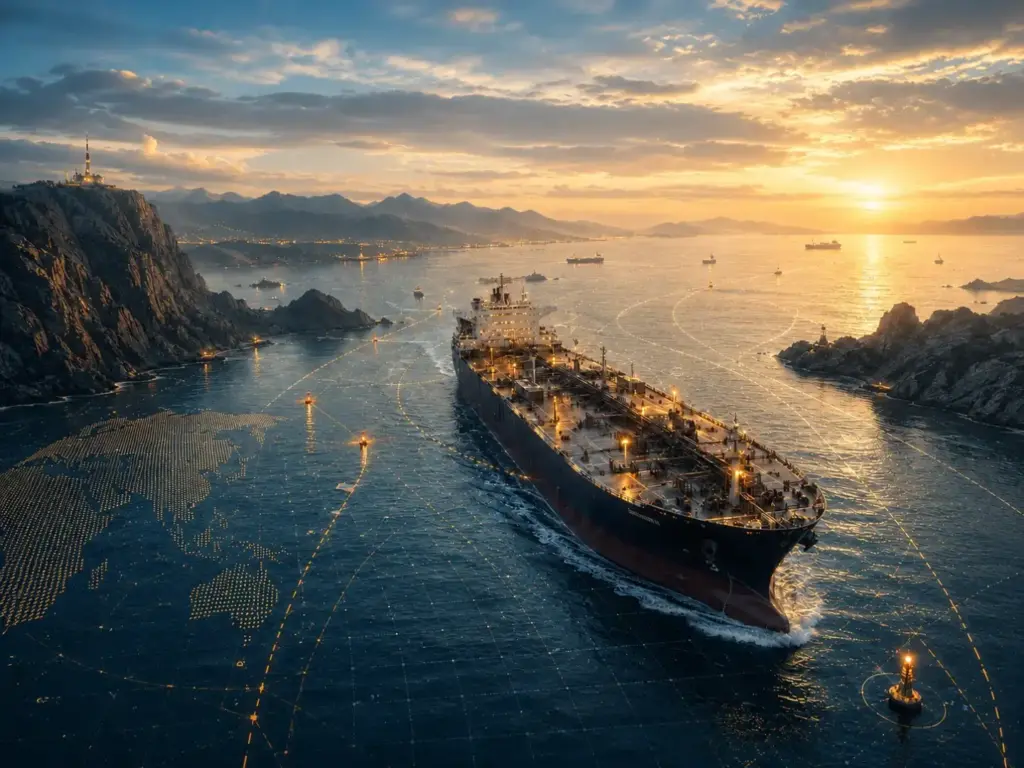
This chapter separates confirmed facts, developments that remain open and analytical chains of effects. The featured image is an illustration and does not depict the verified movement of a specific vessel. Core sources:
- International Maritime Organization — confirmed Middle East incidents — confirmed incidents and seafarer fatalities.
- International Maritime Organization — Red Sea statement, 23 July 2026 — risks to seafarers, shipping and global supply chains.
- International Maritime Organization — Hormuz statement, 8 July 2026 — crew safety and commercial use of the strait.
- International Monetary Fund — World Economic Outlook Update, July 2026 — baseline assumptions and downside risks.
- World Bank — Global Economic Prospects, June 2026 — growth forecast and stress scenario.
Gridizer Research is an analytical publication. It does not constitute financial, legal or political advice.