
Double Standards and the New Power Economy
Why Global Companies Must Price Spheres of Influence Again The post-Cold War assumption was that globalization would gradually reduce the…
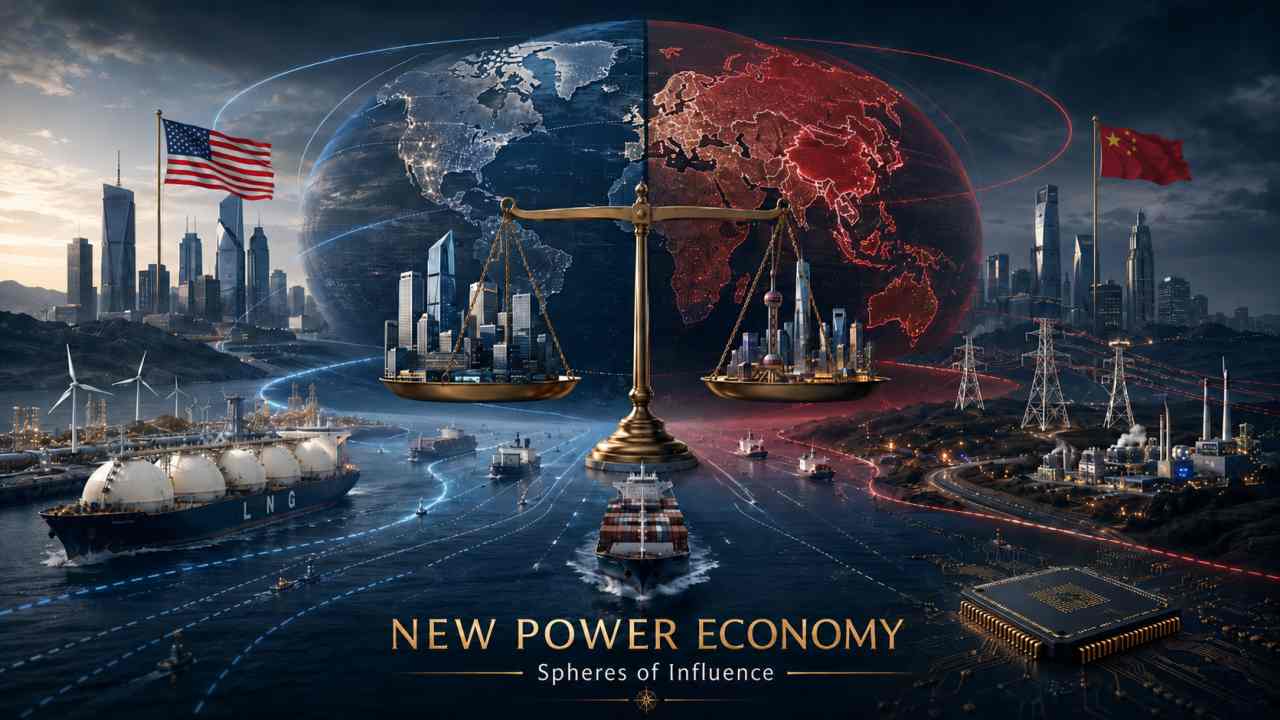
Why Global Companies Must Price Spheres of Influence Again
The post-Cold War assumption was that globalization would gradually reduce the economic importance of spheres of influence. Capital, goods, energy, data and technology were expected to move through rules-based systems. Political risk existed, but it was often treated as an exception.
That assumption is breaking.
The new global economy is not simply deglobalizing. It is becoming more political, more conditional and more security-driven. Companies are no longer operating only in markets. They are operating inside overlapping zones of power.
The central issue is not that rules have disappeared. It is that major powers increasingly apply rules selectively.
The double standard problem
Western governments often describe Russia’s actions in Ukraine as imperial sphere-of-influence politics. That description captures part of the reality. Russia does claim a special security, historical and political role in Ukraine and the wider post-Soviet space.
But from Moscow, Beijing, parts of Latin America, the Gulf, India, Africa and the broader Global South, the Western position looks less clean.
The United States also uses security language to justify pressure in its own strategic neighborhood. In early 2025, U.S. Secretary of State Marco Rubio publicly defended President Trump’s interest in Greenland and the Panama Canal as legitimate national-security concerns tied to Chinese influence in the Arctic and Latin America. From Washington’s perspective, this is strategic defense. From Moscow, Beijing or parts of the Global South, it looks like sphere-of-influence politics under another name. (AP News)
The Greenland and Panama examples are not identical to Ukraine. But they show the key problem: great powers often describe their own strategic perimeter as security, while describing rivals’ strategic perimeters as imperialism.
That perception matters. It weakens the credibility of the Western rules-based order, even among states that do not support Russia’s invasion of Ukraine.
The message received outside the West is simple:
Russia’s sphere of influence is called imperialism. America’s sphere of influence is called security.
Venezuela and the financial power channel
Venezuela offers a longer-running example of U.S. power projection without formal territorial conquest.
Washington has used sanctions, financial restrictions and legal pressure to shape political and economic outcomes in Venezuela. The U.S. Treasury’s Office of Foreign Assets Control states that it administers and enforces sanctions based on U.S. foreign-policy and national-security goals against targeted countries, regimes, individuals and other threats. (OFAC)
That is a central tool of the new power economy: not always military occupation, but access control.
Access to dollars.
Access to payment systems.
Access to insurance.
Access to banks.
Access to shipping.
Access to technology.
Access to legal markets.
From the U.S. perspective, these tools are instruments of national security, anti-corruption policy, anti-drug policy or democratic pressure. From the perspective of rival powers, they are evidence that the Western financial system itself is a geopolitical weapon.
This is why many non-Western states are trying to reduce exposure to dollar sanctions, Western-controlled payment infrastructure, U.S. legal jurisdiction and single-bloc financial dependency.
The return of strategic geography
For global companies, this is not a moral abstraction. It changes cost structures, market access, compliance exposure and valuation.
Panama matters because the canal is a critical logistics corridor. Greenland matters because of the Arctic, rare earths, military geography and access to the North Atlantic. Venezuela matters because of oil, sanctions, regional security and Latin American alignment. Ukraine matters because of Black Sea access, agriculture, energy, defense production, NATO boundaries and Russia’s western security perimeter.
The old globalization map asked:
Where is production cheapest?
The new power economy asks:
- Who controls the corridor?
- Who can sanction the payment?
- Who can insure the cargo?
- Who owns the port?
- Who controls the data?
- Who can cut off chips, software or financing?
- Which bloc will claim this asset in a crisis?
This is a major shift. Political geography is again becoming an input cost.
Fragmentation is now a business variable
The IMF has warned that geoeconomic fragmentation can impose large costs on the world economy. In severe scenarios, long-term global output losses could reach around 7%, with even higher losses for some vulnerable countries. (IMF)
UN Trade and Development describes 2026 as a more complex and fragmented trade environment, shaped by geopolitical tensions, shifting supply chains, digital and green transitions and tighter national regulations. It also notes that export controls and stockpiling are tightening supply and fragmenting value chains. (UN Trade and Development (UNCTAD))
The World Trade Organization’s World Trade Report argues for “re-globalization” rather than fragmentation, precisely because fragmentation threatens security, inclusion and sustainability. (World Trade Organization)
Companies now face a world of overlapping constraints:
- sanctions and counter-sanctions,
- export controls,
- dual-use restrictions,
- data localization,
- energy-security rules,
- forced supply-chain diversification,
- shipping insurance volatility,
- higher inventory requirements,
- friendshoring and nearshoring,
- local-content rules,
- politically sensitive ownership structures.
This does not end globalization. It makes globalization more expensive.
The most exposed companies are those with single-country production, politically sensitive technology, heavy energy needs, complex cross-border finance or dependence on chokepoints. The most resilient companies are those with multi-hub supply chains, pricing power, strong compliance systems, diversified energy access and the ability to operate across political blocs without becoming hostage to one of them.
The new corporate moat
In the old cycle, the strongest corporate moats were brand, scale, network effects, intellectual property and cost advantage.
In the new cycle, those still matter. But a new moat is emerging:
geopolitical survivability.
This includes:
- supply-chain redundancy,
- jurisdictional optionality,
- energy security,
- export-control resilience,
- compliance capability,
- local political legitimacy,
- access to strategic infrastructure,
- and balance-sheet strength.
A semiconductor company is no longer only a technology company. It is a national-security asset.
An LNG exporter is no longer only an energy company. It is a geopolitical allocator of molecules.
A defense company is no longer only a contractor. It is part of a sovereign industrial base.
A data-center operator is no longer only a real-estate or cloud infrastructure play. It is a power, cooling, chips, grid and security platform.
A port operator is no longer only a logistics asset. It is a geopolitical checkpoint.
What investors should price
The market often prices growth, margins and balance sheets. It must now price political alignment risk.
1. Bloc exposure
Is the company overexposed to one political bloc, one chokepoint or one sanction regime?
2. Energy exposure
Can the company access reliable and affordable power, gas, LNG, water and cooling?
3. Supply-chain optionality
Can production move between the U.S., Europe, Mexico, India, ASEAN, Japan, Korea, the Gulf or Latin America?
4. Compliance strength
Can the company survive tighter sanctions, export controls and end-use rules?
5. Strategic relevance
Is the company likely to be protected, subsidized or targeted by governments?
6. Narrative risk
Does the company depend on a political story that could reverse after elections?
Winners and losers
Potential winners in the new power economy:
- defense and air-defense systems,
- drones, sensors, cyber and ISR,
- semiconductors and AI infrastructure,
- LNG and energy-security infrastructure,
- power grids and electrification,
- industrial gases and critical inputs,
- automation and robotics,
- logistics companies with strategic redundancy,
- high-quality global firms with pricing power.
Potential losers:
- energy-intensive producers without pricing power,
- companies dependent on one fragile supply corridor,
- firms exposed to sanctionable jurisdictions,
- highly leveraged capex-heavy businesses,
- European cyclicals without global pricing power,
- companies whose growth depends on stable U.S.-China-EU relations.
Gridizer conclusion
The world is not returning to clean globalization. It is moving into a power economy where market access, energy, logistics, finance and technology are filtered through spheres of influence.
The West may still speak the language of rules. Russia, China and much of the Global South increasingly see selective enforcement. That perception itself becomes a market variable.
For investors, the lesson is direct:
Do not only price earnings. Price sovereignty. Price corridors. Price energy access. Price sanctions. Price political legitimacy.
The new moat is geopolitical survivability.