
GPUs Follow Electricity
AI looks like software but scales like heavy industry. Chapter 6 follows the physical chain from rack-level power density to…
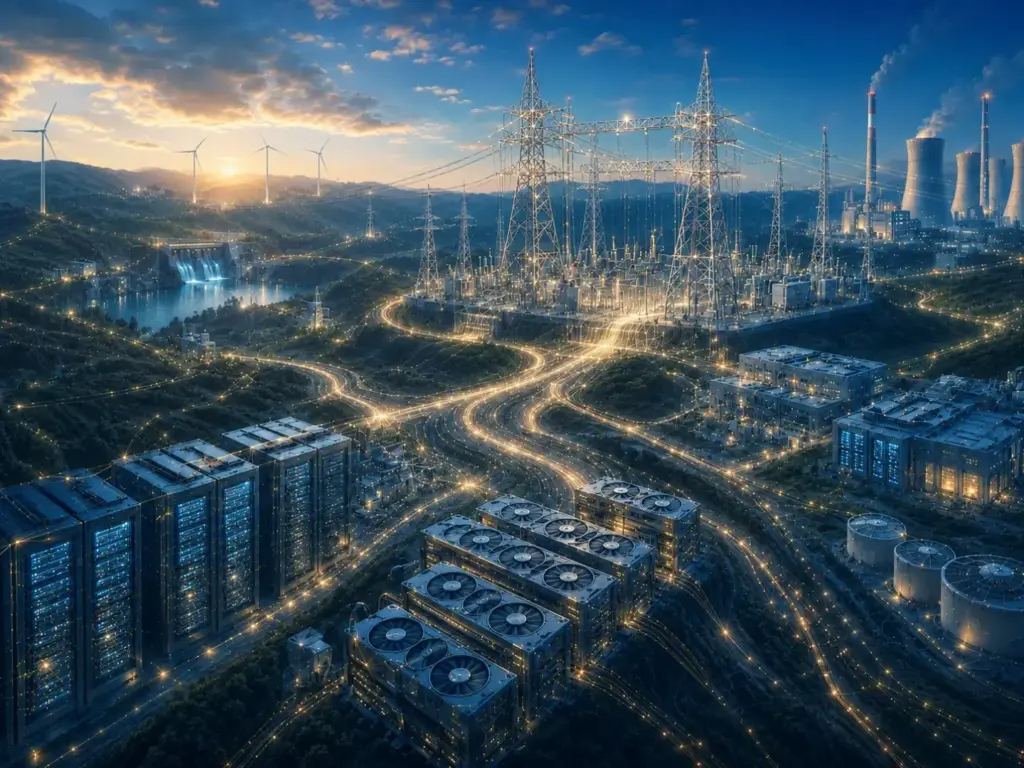
GPUs follow electricity. Where firm power is unavailable, even the best model cannot scale.
The AI industry talks about chips, models and agents. The next bottleneck lies deeper: electricity must be generated, transmitted, transformed, cooled and politically permitted.
Chapter 6 examines the physical chain beneath seemingly weightless intelligence—and why interconnection rights, gas, nuclear power, cooling and local acceptance become strategic assets.
AI Is a Power System
Public debate begins with models and chips. Physical operation begins with an electrical connection built for industrial loads. An AI cluster needs annual energy and continuously available capacity at very high density.
The International Energy Agency projects global data-center electricity consumption to rise from roughly 485 terawatt-hours in 2025 to about 950 terawatt-hours in 2030. AI-focused facilities grow much faster than the rest of the sector.
The U.S. Department of Energy estimates that data centers represented about 4.4% of U.S. electricity consumption in 2023 and could reach roughly 6.7% to 12% by 2028.
This is not ordinary demand growth. A previously unobtrusive digital industry is beginning to compete with households, manufacturing and transport for grid capacity.
Power Density Jumps
A conventional data center could spread load across many racks. Modern AI systems concentrate much more compute inside each unit.
An NVIDIA GB200 NVL72 rack connects 72 Blackwell GPUs and 36 Grace CPUs. NVIDIA documents approximately 120 kilowatts of full-load rack power. Later generations push possible density higher.
One rack is no longer an oversized office server. Hundreds of such systems form an industrial load requiring substations, switchgear, liquid cooling and redundant power paths.
The new bottleneck is not whether a GPU can be ordered. It is whether that GPU can be switched on at this location.
Chips Scale Faster Than Grids
Semiconductor capacity is expensive and slow. Power grids often move even more slowly. New transmission, substations and generation require planning, permits, equipment, construction and political approval.
A hyperscaler can order servers and erect buildings before the utility can provide the required capacity. Competition therefore shifts from chip availability toward speed-to-power.
In June 2026, FERC ordered all six U.S. regional grid operators to justify or reform rules for connecting large loads such as data centers. Who receives service, when and at what cost has become a national infrastructure question.
The interconnection agreement becomes a strategic asset. Land with secured power can be more valuable than a perfect building without a reliable energy path.
The Grid Must Carry the Peak
Annual terawatt-hours tell only half the story. A grid must balance generation, transport and consumption at every moment.
AI clusters often run continuously and can change load rapidly. Training, inference and cooling create large baseloads and additional peaks. Operators need reserves, frequency stability and credible forecasts.
Compute can sometimes shift across hours or regions. Yet real-time inference, critical agents and contracted cloud services require continuous availability.
Flexible compute can support the grid. Inflexible megawatt-scale load can strain it. The difference becomes a pricing variable.
Cooling Is Part of the Energy Architecture
Nearly all electrical energy used inside a data center ultimately becomes heat. Higher rack density therefore increases the importance of liquid cooling, pumps, heat exchangers and heat rejection.
Air cooling reaches practical limits for rack-scale AI systems. Direct liquid cooling improves performance but requires new building, water and maintenance standards.
Location matters. Cooler climates reduce thermal load. Dry regions turn water into a political issue. Dense cities create competition for land, power, pipes and heat disposal.
A superior chip can lose part of its advantage when cooling and power delivery consume too much of total system cost.
Renewables Alone Do Not Solve the Timing Problem
Wind and solar can deliver large volumes of low-cost electricity, but output varies. AI facilities still need power during calm nights and extended low-renewable periods.
The IEA expects renewables to supply nearly half of additional data-center electricity through 2030. Natural gas and, in some regions, coal provide much of the remainder, while nuclear gains importance later in the decade and beyond.
Operators therefore assemble portfolios of power-purchase agreements, grid access, batteries, flexible demand, gas generation and potentially nuclear supply. The objective is not the cheapest isolated kilowatt-hour, but dependable capacity at a predictable cost.
A renewable certificate cannot replace physical capacity in the correct location and hour.
Gas Becomes a Bridge Fuel for AI
Large transmission projects and new nuclear plants take years. Gas generation can be built faster in some regions and can balance variable renewable supply.
Natural gas is therefore a likely near-term beneficiary of AI load growth. It also links digital infrastructure to LNG prices, pipeline capacity, turbine availability and geopolitics.
A Hormuz or LNG shock would not affect households and manufacturing alone. It can raise the power cost of new data centers, weaken project economics and disadvantage regions dependent on imported gas.
AI load growth → new gas generation → higher gas demand → stronger LNG competition → higher electricity and compute costs
Nuclear Gains a New Economic Role
Data centers want large volumes of low-carbon, continuously available power. Nuclear generation matches that profile.
AI demand can improve the economics of license extensions, restarts, new large reactors and smaller modular systems. Timing remains decisive: many projects will deliver long after the current investment wave.
Existing plants with available capacity or direct-contract opportunities possess an immediate advantage. New reactor concepts must still prove licensing, construction cost and industrial scale.
AI will not automatically rescue nuclear power. It does create a creditworthy customer for firm electricity.
Geography Becomes Competitive Strategy
Data centers once followed fiber, customers and tax incentives. They now follow electricity, interconnection, water, climate and political acceptance more closely.
Regions with hydro, nuclear, gas, wind or geothermal resources can become AI-industrial hubs. Others may lose projects despite excellent connectivity because capacity is unavailable on time.
This shift can create winners outside traditional technology centers. Industrial sites, retired power stations and regions with existing high-voltage infrastructure become more valuable.
The cloud remains global. The physics of its locations becomes more regional.
The Bill Reaches the Ratepayer
Transmission upgrades, reserve generation and substations cost money. The political question is who pays.
When a data center triggers a major expansion, regulators can assign cost to the project, other customers or both. Poor rules socialize part of the infrastructure expense while the economic benefit remains private.
FERC and regional regulators are therefore examining interconnection, co-location at power plants, reliability and consumer protection.
Local opposition grows when AI projects raise electricity prices, consume water or displace other industrial connections. Community acceptance becomes another bottleneck.
Capital Moves From the Server to the Substation
The AI capex cycle does not end with GPUs. It pulls investment into turbines, transformers, switchgear, cables, cooling, storage and power generation.
- direct beneficiaries: utilities, generators, transformers, switchgear, cables, cooling and data-center construction
- indirect beneficiaries: gas infrastructure, nuclear power, batteries, engineering and land with secured capacity
- exposed groups: energy-intensive industry in constrained regions, ratepayers under poor cost allocation and projects without interconnection
- valuation risk: hyperscalers when capex grows faster than monetizable AI demand
The real moat may not be model code. It may be the combination of land, interconnection rights, an energy portfolio and permitted cooling.
The Gridizer Research Watchlist
- power demand and rack density of new GPU generations
- interconnection lead times and speed-to-power by region
- transformer, turbine and switchgear delivery times
- FERC, PJM and other large-load interconnection rules
- long-term power contracts signed by hyperscalers
- gas, LNG and electricity-price exposure at major data-center hubs
- water use, liquid cooling and local permitting
- nuclear restarts, extensions and new construction
- AI revenue and free cash flow relative to energy and data-center capex
Intelligence Moves Toward Available Power
AI remains software in its effects but becomes heavy industry in its infrastructure. Winning locations will be selected not only by talent and fiber, but by megawatts, grid stability, water and permits.
GPUs follow electricity. Capital follows the places where that electricity can arrive on time, reliably and at a tolerable price.
Sources and Further Reading
- IEA: Key Questions on Energy and AI – Executive Summary
- IEA: Energy Supply for AI
- U.S. Department of Energy: Electricity Demand Growth Resource Hub
- NVIDIA: DGX GB200 Rack Scale Systems User Guide
- FERC: Action on Large-Load and Data-Center Integration
- U.S. Department of Energy: Resources to Meet Data-Center Electricity Demand