
The Country That Became an AI Derivative
South Korea makes the memory that powers the AI boom. Its stock market then became a concentrated, leveraged wager on…
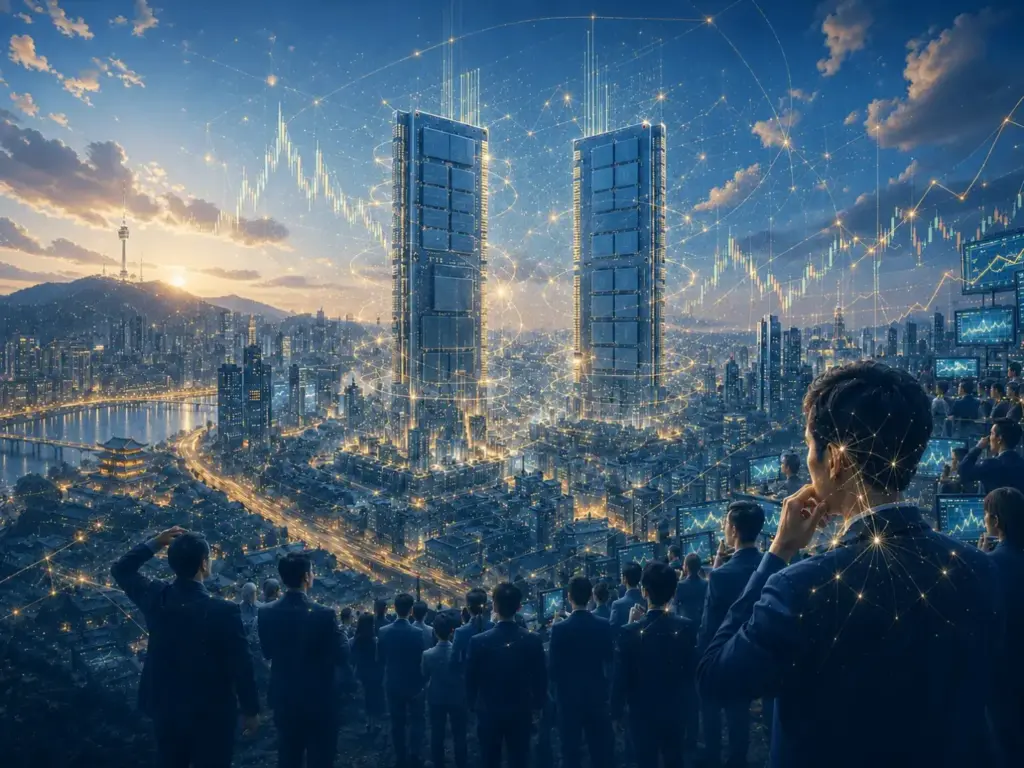
South Korea sold the shovels for the AI gold rush. Then its own stock market began to trade like a leveraged derivative on that rush.
Samsung Electronics and SK hynix sit at the center of the global memory boom. Today’s AI infrastructure cannot scale without their DRAM, NAND and HBM products. Demand is real, profits are exceptional and Korea’s strategic importance has risen.
That strength has also created a new vulnerability. Two companies dominate large parts of the national market. Leveraged products were built on their shares, retail capital flooded in, daily rebalancing amplified moves and prices began to distort their own signals.
Chapter 3 is therefore not a simple bubble story. It shows how a genuine industrial success can be connected to an unstable financial architecture—and why Korea has become an early-warning system for the global AI equity narrative.
The Profits Are Real
Samsung reported operating profit of 57.2 trillion won for the first quarter of 2026. Its semiconductor division reached record levels, supported by memory pricing, HBM4, server DRAM and other AI-related products.
SK hynix generated 37.6 trillion won of operating profit on revenue of 52.6 trillion won in the same quarter. Its operating margin reached 72%. The company attributed the surge to HBM, high-capacity server DRAM, enterprise SSDs and growing inference demand from agentic AI systems.
These figures matter because they reject the easiest explanation. Korea was not lifted by empty AI promises. Its companies produced scarce, strategically important products and earned extraordinary profits.
The problem began when a correct fundamental thesis was translated into an increasingly concentrated and leveraged market structure.
The AI thesis was real. The financial architecture made it dangerous.
Two Companies Became the Market
Samsung and SK hynix grew to a weight that made the Korean benchmark increasingly dependent on two memory producers. The KOSPI became less a broad reflection of the national economy and more an instrument on the global AI capex cycle.
When Microsoft, Amazon, Google, Meta and other hyperscalers expand investment, demand rises for GPUs, HBM and server memory. Samsung and SK hynix benefit. When doubts appear around those budgets, the valuation shock reaches far beyond two stocks.
Concentration changes what the index means. Korea once served as a sensitive bellwether for trade, manufacturing and electronics. The market now reacts more strongly to AI capex, memory prices, U.S. technology valuations and the flows of leveraged products.
The country remains a major industrial power. Its equity market increasingly behaves like a focused bet on one global investment cycle.
May 27 Changed the Mechanics
On May 27, 2026, seven leveraged 2x ETFs and one inverse 2x ETF were launched for each of Samsung and SK hynix. Retail capital entered at a scale that quickly became relevant even for large underlying stocks.
According to the Korea Capital Market Institute, cumulative retail net purchases reached roughly 8.2 trillion won in the leveraged products by June 19. Assets under management grew to about 9.15 trillion won for SK hynix products and 5.22 trillion won for Samsung products.
Capital did not merely enter the market. It moved out of broader semiconductor and index vehicles into concentrated single-stock wagers. Diversification was exchanged for maximum participation in the strongest story.
Investors were no longer simply buying Samsung or SK hynix. They were buying a daily multiple of the price movement inside a market already dominated by the same two shares.
Why Daily Leverage Amplifies Moves
A 2x ETF does not promise twice the long-term return of a stock. It attempts to deliver twice the move of each individual trading day.
That requires daily exposure adjustments:
Stock rises → ETF assets and target exposure rise → additional buying
Stock falls → target exposure shrinks → selling
The mechanism trades in the same direction as the market. During calm periods, its impact can remain limited. During large moves, high fund assets and thinner liquidity turn rebalancing into an amplifier.
KCMI initially estimated direct cash-market rebalancing at an average 1.6% of Samsung trading and 2.1% of SK hynix trading. That sounds manageable. The ratio rises in volatile sessions, while futures, arbitrage, swaps and market-maker hedging can transmit the effect further.
The crucial variable is asset growth. When the stock rises, the net asset value of a leveraged fund rises disproportionately. Even without fresh inflows, the next required adjustment becomes larger. Success enlarges the machine that reinforces the next success.
The Machine Buys the Rally and Sells the Crash
In an upswing, the structure feels comfortable. Gains expand fund assets, rebalancing creates new demand and rising prices attract additional retail capital.
When the direction changes, the same machine runs in reverse. Losses force sales. Margin accounts come under pressure. Investors liquidate other holdings to post collateral. Foreign capital withdraws while retail investors buy the dip.
The price move generates further price moves. Fundamentals become obscured by flows. An earnings report, HBM order or memory-price signal can matter less for the closing price than the exposure that must be reset at the end of the day.
The market no longer merely measures the AI story. It trades the story so aggressively that it can temporarily hide it.
Why the Share Price Is No Longer a Clean Demand Sensor
A falling SK hynix share price may indicate weaker HBM demand. It may also reflect ETF rebalancing, profit-taking, currency stress, margin calls or foreign outflows.
A rising price may reflect strong fundamentals. It may simultaneously exaggerate them through mechanical buying, scarcity of tradable shares and speculative inflows.
Analysts now face a problem: the most important market signal from a central AI supplier contains information and feedback at the same time.
The Korean market is both sensor and amplifier. Reading it as a pure representation of memory demand can lead investors to declare the cycle over too early—or overestimate its strength for too long.
An External Shock Meets Internal Leverage
Korea is unusually vulnerable because financial concentration coincides with macroeconomic dependence. The country imports much of its energy, trades through a volatile currency and sits deeply inside global electronics and export chains.
An oil, LNG or refined-products shock raises the import bill. A weaker won makes energy and capital goods more expensive. The central bank gains less room to ease. Financing costs rise while retail investors already carry heavy borrowing.
That connects the Hormuz chain directly to the AI equity story:
Oil and LNG shock → won pressure → tighter monetary conditions → margin stress → ETF selling → Samsung/SK hynix repricing → global semiconductor risk-off
A geopolitical energy shock does not need to destroy real HBM demand immediately. It only needs to tighten financial conditions enough to force a leveraged structure to reduce exposure.
From Seoul to Wall Street
Korea’s market structure is not a local curiosity. Samsung and SK hynix sit at the center of the global AI supply chain. Their prices influence Micron, TSMC, Nvidia suppliers, semiconductor ETFs and perceptions of the entire AI capex cycle.
When Korea falls sharply, global investors may interpret the move as evidence of a memory peak or capex reversal. Risk models reduce exposure. Passive products and options dealers amplify the adjustment. What begins as technical liquidation in Seoul can end as fundamental repricing in New York.
The reverse also matters. A leverage-driven rally can exaggerate expectations for profits and investment. Companies respond to high valuations with capital raises and larger expansion plans. Financial prices begin to shape real capacity decisions.
That is the most consequential feedback loop: speculative capital does not merely change prices. It can influence the size of the next fab, HBM or data-center cycle.
What Would Signal a Real Memory-Cycle Break
A market crash alone is not enough. A fundamental break requires several real-world signals to align:
- falling HBM contract prices and shorter lead times;
- rising memory inventories at suppliers and customers;
- delayed or cancelled hyperscaler projects;
- lower utilization in foundry and advanced-packaging capacity;
- capex reductions at Samsung, SK hynix or Micron;
- weaker orders for HBM, testing and packaging equipment;
- materially lower AI revenue or free-cash-flow expectations at hyperscalers.
If these signals are absent, the market can break technically while the industrial cycle remains intact. Valuation may then become attractive—but only after leverage has been cleared.
What Korea Teaches About AI Investing
The central lesson is simple: a correct technology thesis is not risk management.
AI may require more memory for years. Samsung and SK hynix may remain strategically indispensable. Investors can still suffer severe losses through valuation, leverage or concentration.
The technology horizon is longer than the life of a margin account. A company can win over five years while a leveraged investor is liquidated next week.
Korea also shows how national indices can lose economic breadth. When a handful of AI suppliers dominate, the market says less about households, services, small businesses and domestic demand.
The Gridizer Research Watchlist
For the AI Capex–HBM Deleveraging Loop, we will monitor:
- AUM and daily rebalancing flows in Samsung and SK hynix products;
- Korean margin lending, forced liquidation and broker limits;
- USD/KRW and Bank of Korea decisions;
- foreign outflows relative to retail inflows;
- HBM and DRAM contract prices, lead times and inventories;
- capex and production plans at Samsung, SK hynix and Micron;
- hyperscaler capex relative to AI revenue, free cash flow and ROIC;
- regulatory restrictions on leveraged single-stock products.
The AI Thesis Can Be Right—and the Trade Can Still Fail
South Korea is not proof that the AI revolution is ending. It shows something more useful: real scarcity, record profits and technological leadership can coexist with a market structure that exaggerates every move.
Korea has become the first major stress test for the financial architecture of the AI boom. The outcome depends not only on how many HBM chips the world needs. It also depends on how much leverage the market can carry, how quickly capital retreats and whether investors can still separate fundamentals from forced flows.
The future of AI may remain bright while its equity narrative passes through a brutal deleveraging cycle.