
The Offer Is Not The Deal
Iran is not too weak to be dangerous — but it is too shaped by the IRGC to implement simple,…
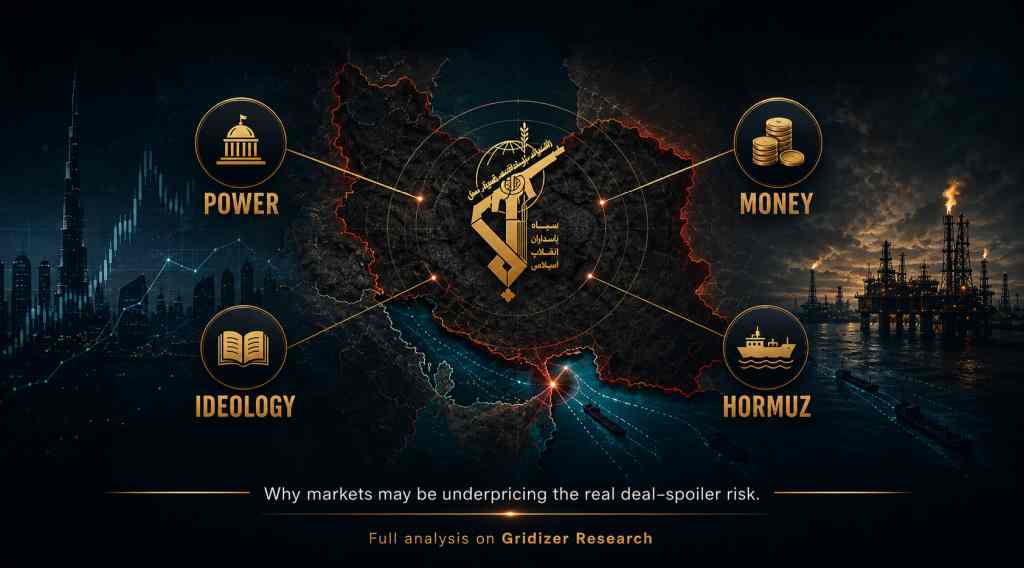
Iran, the IRGC and Negotiability
Why a deal is possible — but not like a normal state agreement
Status: 21 May 2026
The current Iran situation cannot be understood properly if Iran is treated like a conventional nation-state with a conventional army, a conventional foreign ministry, and a conventional cost-benefit calculation. The decisive power node is the Islamic Revolutionary Guard Corps, or IRGC.
The IRGC is not simply a military institution. It is at the same time a regime-protection force, an external operations and proxy coordinator, an economic empire, a sanctions-evasion network, and an ideological mobilization apparatus.
That makes Iran dangerous, but also contradictory. The country is under significant economic, military, and diplomatic pressure. At the same time, there are internal power structures that benefit from isolation, sanctions economics, and escalation. The central question is therefore not only: Does Iran want a deal? The deeper question is: Which parts of the Iranian system would lose power, money, and legitimacy if a real deal were implemented?
1. The current negotiation picture: an offer, not a secured deal
The recent market relief was driven mainly by Donald Trump’s claims that a solution with Iran was close. But this is not yet a reliable peace agreement. The hard conflict point remains Iran’s enriched uranium.
According to Reuters reporting, senior Iranian sources said the Supreme Leader had ordered that Iran’s stockpile of near-weapons-grade uranium must not be transferred out of the country. That directly contradicts a central U.S. and Israeli demand. Trump, in turn, stated that the United States would make sure Iran does not keep that uranium. Israel also demands that Iran remove its enriched uranium from the country and give up major parts of its nuclear and missile programs.
This places negotiations at a classic Iranian threshold: a technical compromise may be possible, but an openly visible capitulation is much harder. For Iranian hardliners, transferring uranium abroad would not merely be a technical nuclear issue. It would be a symbol of humiliation, vulnerability, and strategic disarmament.
A more likely deal structure would therefore not be a simple “Iran ships out its uranium” formula. It would probably need a face-saving mechanism: IAEA-supervised dilution, sealed storage, international technical control, or a third-country/Oman/Russia/IAEA arrangement. The substance would have to be hard, but the symbolism soft.
2. Iran is under heavy pressure — but not automatically ready to surrender
Iran is under pressure on several levels.
First, the U.S. blockade targets vessels entering or leaving Iranian ports. CENTCOM states that the blockade is directed against traffic to and from Iranian ports, while vessels bound for non-Iranian ports in the Strait of Hormuz are not supposed to be impeded. This reduces Iran’s export, import, and hard-currency flexibility without formally shutting down all Gulf traffic.
Second, the maritime situation remains tense. UKMTO/JMIC remains an important reality check because it collects and assesses security reports for commercial shipping. The region is still marked by reduced transits, blockade enforcement, possible mine risks, GNSS disruptions, and incidents near Hormuz. Individual successful tanker passages do not yet mean a return to normal market flows.
Third, the United States continues to target Iran’s shadow-finance and shadow-fleet networks. Recent sanctions have focused on exchange houses, front companies in multiple jurisdictions, and vessels linked to Iranian petroleum and petrochemical trade. That strikes exactly the networks Iran uses to evade sanctions and generate hard currency.
Fourth, pressure is rising on Iran’s regional networks. U.S. sanctions against Hezbollah-aligned individuals and Lebanese political/security figures show that Washington is not only targeting Iran directly, but also trying to weaken the regional architecture of Iranian influence.
Still, pressure does not automatically mean capitulation. Iran retains asymmetrical leverage: Hormuz, drones, missiles, mines, proxies, cyber capabilities, maritime disruption, and selective passage politics. Iran is weakened, but not harmless.
3. The IRGC: not a normal military
The IRGC is the decisive actor because it combines several functions that would normally be separated in Western states.
It protects the theocratic regime, controls key parts of the internal security architecture, operates its own land, air, naval, missile, and special forces, and supervises Iran’s relations with regional partners and proxies through the Quds Force.
At the same time, the IRGC is an economic power structure. Khatam al-Anbiya, widely described as an IRGC-linked construction and engineering arm, is involved in infrastructure, energy, pipelines, roads, tunnels, water projects, and industry. IRGC-linked networks are deeply embedded in oil, gas, construction, telecommunications, transport, and strategic infrastructure.
This dual role is crucial. The IRGC does not merely survive under sanctions. It can partly benefit from them. Isolation, shadow trade, smuggling, monopolies, special permissions, military control, and informal networks create rents. A real market opening could threaten many of those advantages.
4. Why the IRGC can be a deal spoiler
A normal state might decide rationally: sanctions relief, higher exports, more investment — a deal is good.
For the IRGC, the calculation is more complicated.
A real deal could mean:
- fewer sanctions rents,
- lower smuggling margins,
- less control over strategic ports, transit routes, and hard-currency channels,
- less budgetary room for proxies,
- less justification for domestic exceptional power,
- more civilian and foreign competition in sectors controlled by IRGC-linked networks.
The IRGC may therefore have an institutional interest in preventing, weakening, delaying, or monetizing a deal. It does not necessarily need to oppose a deal openly. It can raise the cost of implementation through proxy escalation, maritime risks, technical delays, hardliner narratives, or security demands.
That is what makes Iran’s negotiability so difficult to assess. Diplomats may negotiate, but the real power question is whether the IRGC accepts the deal, undermines it, or turns it into a new source of leverage.
5. The ideological layer: important, but not the only explanation
Iranian politics is not purely religious. It is also about power, economics, security, and geopolitics. Still, the revolutionary-ideological layer matters because it defines which compromises can be accepted.
The Islamic Republic legitimizes itself through concepts such as resistance, sovereignty, martyrdom, anti-imperialism, protection of the revolution, and opposition to Israel and Western pressure. This language is not merely propaganda. It shapes which retreats are seen as betrayal and which can be framed as tactical endurance.
That is why Iran is not impossible to negotiate with. History shows that even revolutionary leadership can accept compromises under pressure. But Iran is highly sensitive to visible humiliation. Concessions have to be structured in a way that does not make the core of the system appear publicly defeated.
The precise formula is:
Iranian hardliners do not surrender when surrender is visibly framed as religious-revolutionary capitulation. But they can make tactical concessions if those concessions can be presented as resistance, strategic patience, technical necessity, or protection of the revolution.
6. Strengths of the IRGC
The IRGC has several strengths that make it dangerous even under heavy pressure.
First: asymmetrical escalation capability. Iran does not need to win a conventional war to move global markets. It only needs to raise the cost of shipping, insurance, energy flows, and geopolitical planning.
Second: proxy networks. Through the Quds Force and regional partners, Iran can project pressure beyond its borders. Hezbollah, Houthi structures, and other actors are part of this strategic forward layer.
Third: economic embeddedness. Because the IRGC is involved in key economic sectors, it controls not only weapons, but also resources, contracts, logistics, and patronage.
Fourth: regime-protection function. In domestic crises, the IRGC is not merely an external defender; it is at the core of regime survival.
Fifth: ideological mobilization. It can legitimize endurance, sacrifice, and escalation when civilian technocrats might already prefer compromise.
7. Weaknesses of the IRGC
The same characteristics also create structural weaknesses.
First: corruption and inefficiency. A security-driven shadow economy produces monopolies, loyalty networks, and low transparency. This damages long-term productivity and innovation.
Second: dependence on isolation. If a power apparatus benefits from sanctions, closed markets, and informal networks, normalization becomes a threat. That makes Iran less reform-capable.
Third: conflict between state interest and organizational interest. The Iranian state needs growth, hard currency, trade, and relief. The IRGC needs control, exceptional power, and strategic tension. These interests do not always align.
Fourth: exposed networks. The more the IRGC relies on economic networks, shadow fleets, proxy finance, and smuggling channels, the more attack surfaces it creates for sanctions, financial surveillance, cyber operations, intelligence work, and military deterrence.
Fifth: China and Russia are not religious allies. They use Iran strategically, but they do not want an uncontrollable energy collapse. China in particular needs stable energy and trade flows. That limits Iran’s room for maneuver.
8. What this means for negotiations
A durable Iran deal has to address three levels at once:
- The technical level: uranium, inspections, enrichment, missiles, shipping mechanisms.
- The power level: what does the IRGC lose or gain?
- The symbolic level: can Iran make concessions without appearing publicly defeated?
A deal that is logical only on the technical level can fail domestically. A deal that offers only symbolism will not satisfy Israel or the United States. The challenge is hard substance with soft packaging.
Realistic elements could include:
- IAEA-supervised securing or dilution of uranium,
- technical custody rather than public “surrender” of material,
- staged sanctions relief in exchange for verifiable steps,
- Oman/Qatar/IAEA as face-saving channels,
- clear shipping protocols for Hormuz,
- limited but verifiable de-escalation of key military pathways,
- mechanisms against proxy resupply and shadow financing.
The West has to understand: a treaty with Iran is only as stable as the incentive structure of the IRGC behind it.
9. How much pressure is Iran really under?
Iran is under heavy pressure, but not in a state of automatic surrender.
Very high pressure: oil exports, hard currency channels, sanctions, shadow finance, military costs, international isolation.
High pressure: nuclear negotiations, Hormuz control, regional proxies, domestic economic stress.
Remaining strength: asymmetric escalation, IRGC networks, revolutionary mobilization, strategic depth through proxies.
Largest deal risk: uranium removal, visible humiliation, loss of IRGC rents, and Israeli rejection of a deal perceived as too soft.
This is why market reactions can be misleading. If oil falls because Trump suggests a deal is close, that does not mean Iran is internally and militarily ready to implement it. The market trades probability; the IRGC trades power, control, and survival.
10. Conclusion
Iran is negotiable, but not like a normal state. The real negotiation question is not only whether Tehran is suffering enough economically. The question is whether the most powerful internal actors — especially the IRGC — can accept a deal as survivable, rent-preserving, and ideologically marketable.
The IRGC is both the strength and the weakness of the system. It protects the regime, controls strategic levers, enables asymmetric pressure, and organizes regional power projection. At the same time, it makes Iran more corrupt, more isolated, less market-capable, and harder to compromise with.
The most likely path to a deal is therefore not public capitulation. It is a technical compromise, mediated through face-saving channels, backed by hard verification. The most likely path to failure runs through the same points where IRGC interests, revolutionary symbolism, and Israeli security demands become incompatible.
Core sentence:
Iran is not too weak to be dangerous — but it is too shaped by the IRGC to implement simple, economically rational compromises with certainty. A deal is possible, but only if it accounts for the IRGC’s power logic, the revolutionary symbolic framework, and Israel’s hard security requirements at the same time.